Genesis 2:16–23
The NET BibleOther versions
English
- NET The NET Bible
- DARBY 1890 Darby Bible
- ASV American Standard Version
- AV 1873 The Cambridge Paragraph Bible of the Authorized English Version
- CSB Christian Standard Bible
- D-R Douay-Rheims Bible
- ESV English Standard Version
- GW GOD’S WORD Translation
- GNB Good News Translation
- HCSB The Holman Christian Standard Bible
- KJV 1900 King James Version
- LSB Legacy Standard Bible
- LEB The Lexham English Bible
- MSG The Message: The Bible in Contemporary Language
- NASB95 New American Standard Bible (1995)
- NCV New Century Version
- NIrV New International Reader’s Version (1998)
- NIV New International Version (2011)
- NKJV The New King James Version
- NLT New Living Translation
- NRSVue New Revised Standard Version: Updated Edition
- RSV The Revised Standard Version
- RSVCE The Revised Standard Version, Catholic Edition
- YLT Young’s Literal Translation
Arabic
Czech
French
German
Hebrew
Hungarian
Italian
Korean
Latin
Portuguese
Russian
Simplified Chinese
Spanish
Traditional Chinese
2:16Then the Lord God commanded48 the man, “You may freely eat49 fruit50 from every tree of the orchard, 2:17but51 you must not eat52 from the tree of the knowledge of good and evil, for when53 you eat from it you will surely die.”54
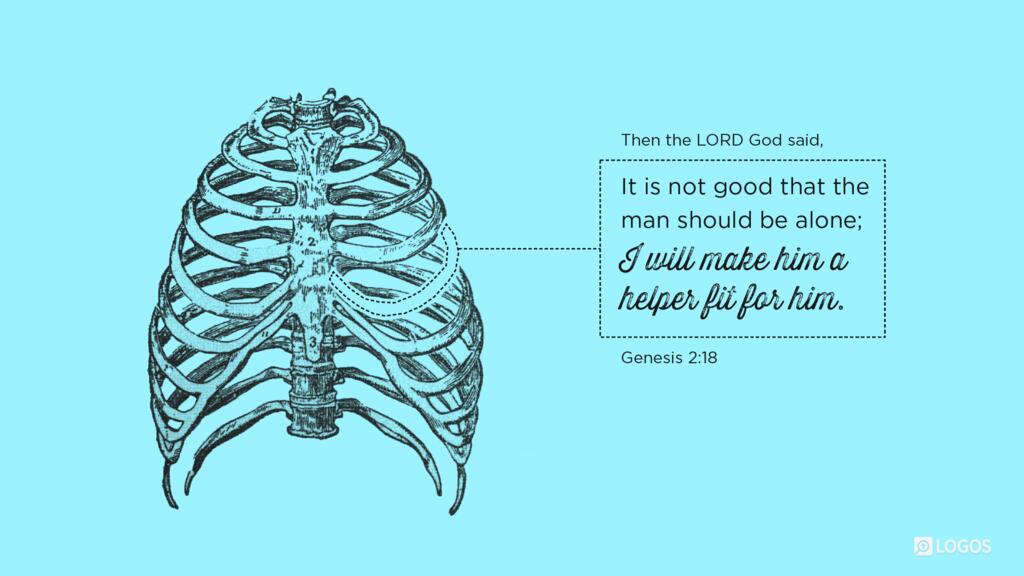
2:18The Lord God said, “It is not good for the man to be alone.55 I will make a companion56 for him who corresponds to him.”57 2:19The Lord God formed58 out of the ground every living animal of the field and every bird of the air. He brought them to the man to see what he would59 name them, and whatever the man called each living creature, that was its name. 2:20So the man named all the animals, the birds of the air, and the living creatures of the field, but for Adam60 no companion who corresponded to him was found.61 2:21So the Lord God caused the man to fall into a deep sleep,62 and while he was asleep,63 he took part of the man’s side64 and closed up the place with flesh.65 2:22Then the Lord God made66 a woman from the part he had taken out of the man, and he brought her to the man. 2:23Then the man said,
“This one at last67 is bone of my bones
and flesh of my flesh;
this one will be called68 ‘woman,’
Footnotes
- 48 This is the first time in the Bible that the verb tsavah (צָוָה, “to command”) appears. Whatever the man had to do in the garden, the main focus of the narrative is on keeping God’s commandments. God created humans with the capacity to obey him and then tested them with commands.
- 49 The imperfect verb form probably carries the nuance of permission (“you may eat”) since the man is not being commanded to eat from every tree. The accompanying infinitive absolute adds emphasis: “you may freely eat,” or “you may eat to your heart’s content.”
- 50 The word “fruit” is not in the Hebrew text, but is implied as the direct object of the verb “eat.” Presumably the only part of the tree the man would eat would be its fruit (cf. 3:2).
- 51 The disjunctive clause here indicates contrast: “but from the tree of the knowledge.…”
- 52 The negated imperfect verb form indicates prohibition, “you must not eat.”
- 53 Or “in the very day, as soon as.” If one understands the expression to have this more precise meaning, then the following narrative presents a problem, for the man does not die physically as soon as he eats from the tree. In this case one may argue that spiritual death is in view. If physical death is in view here, there are two options to explain the following narrative: (1) The following phrase “You will surely die” concerns mortality which ultimately results in death (a natural paraphrase would be, “You will become mortal”), or (2) God mercifully gave man a reprieve, allowing him to live longer than he deserved.
- 54 Heb “dying you will die.” The imperfect verb form here has the nuance of the specific future because it is introduced with the temporal clause, “when you eat … you will die.” That certainty is underscored with the infinitive absolute, “you will surely die.” The Hebrew text (“dying you will die”) does not refer to two aspects of death (“dying spiritually, you will then die physically”). The construction simply emphasizes the certainty of death, however it is defined. Death is essentially separation. To die physically means separation from the land of the living, but not extinction. To die spiritually means to be separated from God. Both occur with sin, although the physical alienation is more gradual than instant, and the spiritual is immediate, although the effects of it continue the separation.
- 55 Heb “The being of man by himself is not good.” The meaning of “good” must be defined contextually. Within the context of creation, in which God instructs humankind to be fruitful and multiply, the man alone cannot comply. Being alone prevents the man from fulfilling the design of creation and therefore is not good.
- 56 Traditionally “helper.” The English word “helper,” because it can connote so many different ideas, does not accurately convey the connotation of the Hebrew word עֵזֶר (’ezer). Usage of the Hebrew term does not suggest a subordinate role, a connotation which English “helper” can have. In the Bible God is frequently described as the “helper,” the one who does for us what we cannot do for ourselves, the one who meets our needs. In this context the word seems to express the idea of an “indispensable companion.” The woman would supply what the man was lacking in the design of creation and logically it would follow that the man would supply what she was lacking, although that is not stated here. See further M. L. Rosenzweig, “A Helper Equal to Him,” 139 (1986): 277–80.
- 57 The Hebrew expression כְּנֶגְדּוֹ (kénegdo) literally means “according to the opposite of him.” Translations such as “suitable [for]” (, ), “matching,” “corresponding to” all capture the idea. (Translations that render the phrase simply “partner” [cf. , ], while not totally inaccurate, do not reflect the nuance of correspondence and/or suitability.) The man’s form and nature are matched by the woman’s as she reflects him and complements him. Together they correspond. In short, this prepositional phrase indicates that she has everything that God had invested in him.
- 58 Or “fashioned.” To harmonize the order of events with the chronology of chapter one, some translate the prefixed verb form with vav (ו) consecutive as a past perfect (“had formed,” cf. ) here. (In chapter one the creation of the animals preceded the creation of man; here the animals are created after the man.) However, it is unlikely that the Hebrew construction can be translated in this way in the middle of this pericope, for the criteria for unmarked temporal overlay are not present here. See S. R. Driver, A Treatise on the Use of the Tenses in Hebrew, , and especially R. Buth, “Methodological Collision between Source Criticism and Discourse Analysis,” Biblical Hebrew and Discourse Linguistics, 138–54. For a contrary viewpoint see §33.2.3 and C. J. Collins, “The Wayyiqtol as ‘Pluperfect’: When and Why,” 46 (1995): .
- 59 The imperfect verb form is future from the perspective of the past time narrative.
- 60 Here for the first time the Hebrew word אָדָם (’adam) appears without the article, suggesting that it might now be the name “Adam” rather than “[the] man.” Translations of the Bible differ as to where they make the change from “man” to “Adam” (e.g., and translate “Adam” here, while and continue to use “the man”; the uses “Adam” twice in v. 19).
- 61 Heb “there was not found a companion who corresponded to him.” The subject of the third masculine singular verb form is indefinite. Without a formally expressed subject the verb may be translated as passive: “one did not find = there was not found.”
- 62 Heb “And the Lord God caused a deep sleep to fall on the man.”
- 63 Heb “and he slept.” In the sequence the verb may be subordinated to the following verb to indicate a temporal clause (“while …”).
- 64 Traditionally translated “rib,” the Hebrew word actually means “side.” The Hebrew text reads, “and he took one from his sides,” which could be rendered “part of his sides.” That idea may fit better the explanation by the man that the woman is his flesh and bone.
- 65 Heb “closed up the flesh under it.”
- 66 The Hebrew verb is בָּנָה (banah, “to make, to build, to construct”). The text states that the Lord God built the rib into a woman. Again, the passage gives no indication of precisely how this was done.
- 67 The Hebrew term הַפַּעַם (happa’am) means “the [this] time, this place,” or “now, finally, at last.” The expression conveys the futility of the man while naming the animals and finding no one who corresponded to him.
- 68 The Hebrew text is very precise, stating: “of this one it will be said, ‘woman’.” The text is not necessarily saying that the man named his wife—that comes after the fall (Gen 3:20). Some argue that naming implies the man’s authority or ownership over the woman here. Naming can indicate ownership or authority if one is calling someone or something by one’s name and/or calling a name over someone or something (see 2 Sam 12:28; 2 Chr 7:14; Isa 4:1; Jer 7:14; 15:16), especially if one is conquering and renaming a site. But the idiomatic construction used here (the Niphal of קָרָא, qara’, with preposition lamed [לְ, lé]) does not suggest such an idea. In each case where it is used, the one naming discerns something about the object being named and gives it an appropriate name (See 1 Sam 9:9; 2 Sam 18:18; Prov 16:21; Isa 1:26; 32:5; 35:8; 62:4, 12; Jer 19:6). Adam is not so much naming the woman as he is discerning her close relationship to him and referring to her accordingly. He may simply be anticipating that she will be given an appropriate name based on the discernible similarity.
- 69 Or “from” (but see v. 22).
- 70 This poetic section expresses the correspondence between the man and the woman. She is bone of his bones, flesh of his flesh. Note the wordplay (paronomasia) between “woman” (אִשָּׁה, ’ishah) and “man” (אִישׁ, ’ish). On the surface it appears that the word for woman is the feminine form of the word for man. But the two words are not etymologically related. The sound and the sense give that impression, however, and make for a more effective wordplay.
The NET Bible First Edition, Copyright 1996-2005 by Biblical Studies Press