Genesis 1:5–6
The NET BibleOther versions
English
- NET The NET Bible
- DARBY 1890 Darby Bible
- ASV American Standard Version
- AV 1873 The Cambridge Paragraph Bible of the Authorized English Version
- CSB Christian Standard Bible
- D-R Douay-Rheims Bible
- ESV English Standard Version
- GW GOD’S WORD Translation
- GNB Good News Translation
- HCSB The Holman Christian Standard Bible
- KJV 1900 King James Version
- LSB Legacy Standard Bible
- LEB The Lexham English Bible
- MSG The Message: The Bible in Contemporary Language
- NASB95 New American Standard Bible (1995)
- NCV New Century Version
- NIrV New International Reader’s Version (1998)
- NIV New International Version (2011)
- NKJV The New King James Version
- NLT New Living Translation
- NRSVue New Revised Standard Version: Updated Edition
- RSV The Revised Standard Version
- RSVCE The Revised Standard Version, Catholic Edition
- YLT Young’s Literal Translation
Arabic
Czech
French
German
Hebrew
Hungarian
Italian
Korean
Latin
Portuguese
Russian
Simplified Chinese
Spanish
Traditional Chinese
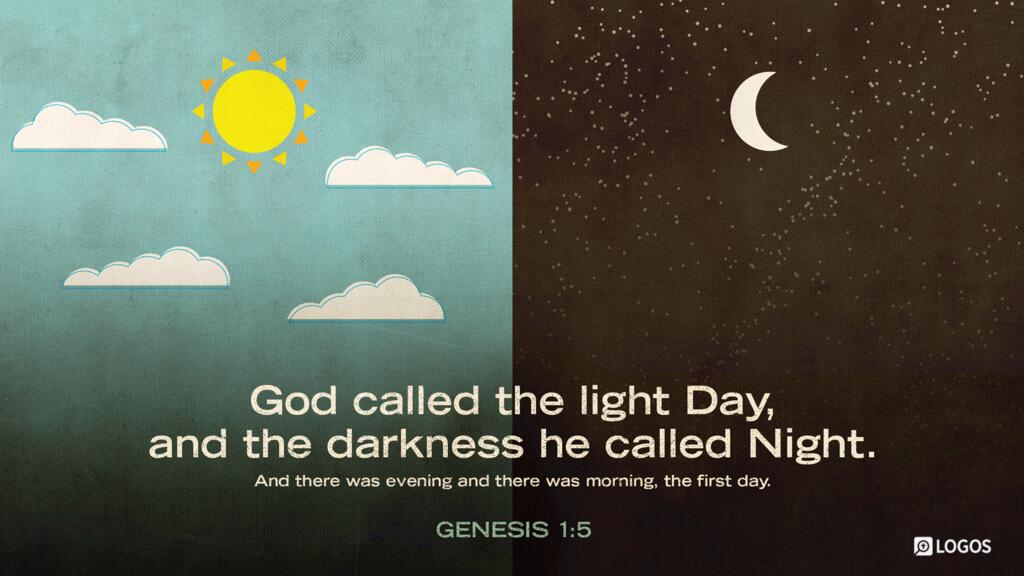
1:5God called20 the light “day” and the darkness21 “night.” There was evening, and there was morning, marking the first day.22
1:6God said, “Let there be an expanse23 in the midst of the waters and let it separate water24 from water.
Footnotes
- 20 Heb “he called to,” meaning “he named.” God called. Seven times in this chapter naming or blessing follows some act of creation. There is clearly a point being made beyond the obvious idea of naming. In the Babylonian creation story Enuma Elish, naming is equal to creating. In the Bible the act of naming, like creating, can be an indication of sovereignty (see 2 Kgs 23:34). In this verse God is sovereign even over the darkness.
- 21 Heb “and the darkness he called night.” The words “he called” have not been repeated in the translation for stylistic reasons.
- 22 Another option is to translate, “Evening came, and then morning came.” This formula closes the six days of creation. It seems to follow the Jewish order of reckoning time: from evening to morning. Day one started with the dark, continued through the creation of light, and ended with nightfall. Another alternative would be to translate, “There was night and then there was day, one day.” The first day. The exegetical evidence suggests the word “day” in this chapter refers to a literal twenty-four hour day. It is true that the word can refer to a longer period of time (see Isa 61:2, or the idiom in 2:4, “in the day,” that is, “when”). But this chapter uses “day,” “night,” “morning,” “evening,” “years,” and “seasons.” Consistency would require sorting out how all these terms could be used to express ages. Also, when the Hebrew word יוֹם (yom) is used with a numerical adjective, it refers to a literal day. Furthermore, the commandment to keep the sabbath clearly favors this interpretation. One is to work for six days and then rest on the seventh, just as God did when he worked at creation.
- 23 The Hebrew word refers to an expanse of air pressure between the surface of the sea and the clouds, separating water below from water above. In v. 8 it is called “sky.” An expanse. In the poetic texts the writers envision, among other things, something rather strong and shiny, no doubt influencing the traditional translation “firmament” (cf. “dome”). Job 37:18 refers to the skies poured out like a molten mirror. Dan 12:3 and Ezek 1:22 portray it as shiny. The sky or atmosphere may have seemed like a glass dome. For a detailed study of the Hebrew conception of the heavens and sky, see L. I. J. Stadelmann, The Hebrew Conception of the World (), 37–60.
- 24 Heb “the waters from the waters.”
The NET Bible First Edition, Copyright 1996-2005 by Biblical Studies Press
In other versions
ESVEnglish Standard Version
God called the light Day, and the darkness he called Night. And there was evening and there was morning, the first day.
And God said, “Let there be an expanse in the midst of the waters, and let it separate the waters from the waters.”
Copyright 2001 Crossway Bibles
NIVNew International Version (2011)
God called the light “day,” and the darkness he called “night.” And there was evening, and there was morning—the first day.
And God said, “Let there be a vault between the waters to separate water from water.”
Copyright 1973, 1978, 1984, 2011 Biblica, Inc.
CSBChristian Standard Bible
God called the light “day,” and the darkness he called “night.” There was an evening, and there was a morning: one day.
Then God said, “Let there be an expanse between the waters, separating water from water.”
Copyright 2017 Holman Bible Publishers
NLTNew Living Translation
God called the light “day” and the darkness “night.”
And evening passed and morning came, marking the first day.
Then God said, “Let there be a space between the waters, to separate the waters of the heavens from the waters of the earth.”
Holy Bible, New Living Translation, copyright © 1996, 2004, 2015 by Tyndale House Foundation. Used by permission of Tyndale House Publishers. All rights reserved.
LEBThe Lexham English Bible
And God called the light Day, and the darkness he called Night. And there was evening and there was morning, the first day.
And God said, “Let there be a vaulted dome in the midst of the waters, and let it cause a separation between the waters.”
Copyright 2012 Lexham Press
KJV 1900King James Version
And God called the light Day, and the darkness he called Night. And the evening and the morning were the first day.
And God said, Let there be a firmament in the midst of the waters, and let it divide the waters from the waters.
Public Domain