Genesis 1:11–16
The NET BibleOther versions
English
- NET The NET Bible
- DARBY 1890 Darby Bible
- ASV American Standard Version
- AV 1873 The Cambridge Paragraph Bible of the Authorized English Version
- CSB Christian Standard Bible
- D-R Douay-Rheims Bible
- ESV English Standard Version
- GW GOD’S WORD Translation
- GNB Good News Translation
- HCSB The Holman Christian Standard Bible
- KJV 1900 King James Version
- LSB Legacy Standard Bible
- LEB The Lexham English Bible
- MSG The Message: The Bible in Contemporary Language
- NASB95 New American Standard Bible (1995)
- NCV New Century Version
- NIrV New International Reader’s Version (1998)
- NIV New International Version (2011)
- NKJV The New King James Version
- NLT New Living Translation
- NRSVue New Revised Standard Version: Updated Edition
- RSV The Revised Standard Version
- RSVCE The Revised Standard Version, Catholic Edition
- YLT Young’s Literal Translation
Arabic
Czech
French
German
Hebrew
Hungarian
Italian
Korean
Latin
Portuguese
Russian
Simplified Chinese
Spanish
Traditional Chinese
1:11God said, “Let the land produce vegetation:31 plants yielding seeds according to their kinds,32 and33 trees bearing fruit with seed in it according to their kinds.” It was so. 1:12The land produced vegetation—plants yielding seeds according to their kinds, and trees bearing fruit with seed in it according to their kinds. God saw that it was good. 1:13There was evening, and there was morning, a third day.
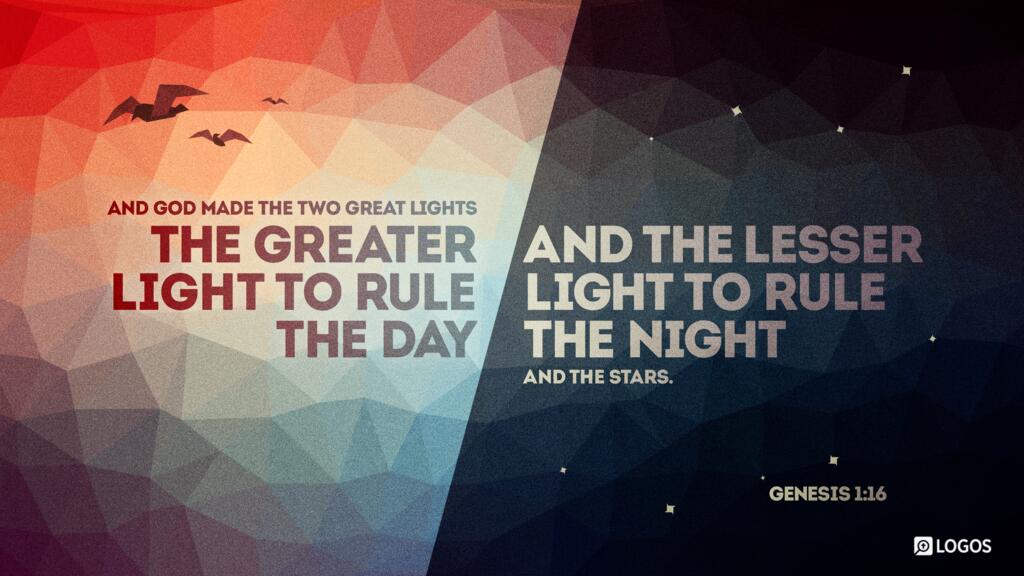
1:14God said, “Let there be lights34 in the expanse35 of the sky to separate the day from the night, and let them be signs36 to indicate seasons and days and years, 1:15and let them serve as lights in the expanse of the sky to give light on the earth.” It was so. 1:16God made two great lights37—the greater light to rule over the day and the lesser light to rule over the night. He made the stars also.38
Footnotes
- 31 The Hebrew construction employs a cognate accusative, where the nominal object (“vegetation”) derives from the verbal root employed. It stresses the abundant productivity that God created. Vegetation. The Hebrew word translated “vegetation” (דֶּשֶׁא, deshe’) normally means “grass,” but here it probably refers more generally to vegetation that includes many of the plants and trees. In the verse the plants and the trees are qualified as self-perpetuating with seeds, but not the word “vegetation,” indicating it is the general term and the other two terms are sub-categories of it. Moreover, in vv. 29 and 30 the word vegetation/grass does not appear. The Samaritan Pentateuch adds an “and” before the fruit trees, indicating it saw the arrangement as bipartite (The Samaritan Pentateuch tends to eliminate asyndetic constructions).
- 32 After their kinds. The Hebrew word translated “kind” (מִין, min) indicates again that God was concerned with defining and dividing time, space, and species. The point is that creation was with order, as opposed to chaos. And what God created and distinguished with boundaries was not to be confused (see Lev 19:19 and Deut 22:9–11).
- 33 The conjunction “and” is not in the Hebrew text, but has been supplied in the translation to clarify the relationship of the clauses.
- 34 Let there be lights. Light itself was created before the light-bearers. The order would not seem strange to the ancient Hebrew mind that did not automatically link daylight with the sun (note that dawn and dusk appear to have light without the sun).
- 35 The language describing the cosmos, which reflects a prescientific view of the world, must be interpreted as phenomenal, describing what appears to be the case. The sun and the moon are not in the sky (below the clouds), but from the viewpoint of a person standing on the earth, they appear that way. Even today we use similar phenomenological expressions, such as “the sun is rising” or “the stars in the sky.”
- 36 The text has “for signs and for seasons and for days and years.” It seems likely from the meanings of the words involved that “signs” is the main idea, followed by two categories, “seasons” and “days and years.” This is the simplest explanation, and one that matches vv. 11–13. It could even be rendered “signs for the fixed seasons, that is [explicative vav (ו)] days and years.” Let them be for signs. The point is that the sun and the moon were important to fix the days for the seasonal celebrations for the worshiping community.
- 37 Two great lights. The text goes to great length to discuss the creation of these lights, suggesting that the subject was very important to the ancients. Since these “lights” were considered deities in the ancient world, the section serves as a strong polemic (see G. Hasel, “The Polemical Nature of the Genesis Cosmology,” 46 [1974]: 81–102). The Book of Genesis is affirming they are created entities, not deities. To underscore this the text does not even give them names. If used here, the usual names for the sun and moon [Shemesh and Yarih, respectively] might have carried pagan connotations, so they are simply described as greater and lesser lights. Moreover, they serve in the capacity that God gives them, which would not be the normal function the pagans ascribed to them. They merely divide, govern, and give light in God’s creation.
- 38 Heb “and the stars.” Now the term “stars” is added as a third object of the verb “made.” Perhaps the language is phenomenological, meaning that the stars appeared in the sky from this time forward.
The NET Bible First Edition, Copyright 1996-2005 by Biblical Studies Press
In other versions
ESVEnglish Standard Version
And God said, “Let the earth sprout vegetation, plants yielding seed, and fruit trees bearing fruit in which is their seed, each according to its kind, on the earth.” And it was so. The earth brought forth vegetation, plants yielding seed according to their own kinds, and trees bearing fruit in which is their seed, each according to its kind. And God saw that it was good. And there was evening and there was morning, the third day.
And God said, “Let there be lights in the expanse of the heavens to separate the day from the night. And let them be for signs and for seasons, and for days and years, and let them be lights in the expanse of the heavens to give light upon the earth.” And it was so. And God made the two great lights—the greater light to rule the day and the lesser light to rule the night—and the stars.
Copyright 2001 Crossway Bibles
NIVNew International Version (2011)
Then God said, “Let the land produce vegetation: seed-bearing plants and trees on the land that bear fruit with seed in it, according to their various kinds.” And it was so. The land produced vegetation: plants bearing seed according to their kinds and trees bearing fruit with seed in it according to their kinds. And God saw that it was good. And there was evening, and there was morning—the third day.
And God said, “Let there be lights in the vault of the sky to separate the day from the night, and let them serve as signs to mark sacred times, and days and years, and let them be lights in the vault of the sky to give light on the earth.” And it was so. God made two great lights—the greater light to govern the day and the lesser light to govern the night. He also made the stars.
Copyright 1973, 1978, 1984, 2011 Biblica, Inc.
CSBChristian Standard Bible
Then God said, “Let the earth produce vegetation: seed-bearing plants and fruit trees on the earth bearing fruit with seed in it according to their kinds.” And it was so. The earth produced vegetation: seed-bearing plants according to their kinds and trees bearing fruit with seed in it according to their kinds. And God saw that it was good. Evening came and then morning: the third day.
Then God said, “Let there be lights in the expanse of the sky to separate the day from the night. They will serve as signs for seasons and for days and years. They will be lights in the expanse of the sky to provide light on the earth.” And it was so. God made the two great lights—the greater light to rule over the day and the lesser light to rule over the night—as well as the stars.
Copyright 2017 Holman Bible Publishers
NLTNew Living Translation
Then God said, “Let the land sprout with vegetation—every sort of seed-bearing plant, and trees that grow seed-bearing fruit. These seeds will then produce the kinds of plants and trees from which they came.” And that is what happened. The land produced vegetation—all sorts of seed-bearing plants, and trees with seed-bearing fruit. Their seeds produced plants and trees of the same kind. And God saw that it was good.
And evening passed and morning came, marking the third day.
Then God said, “Let lights appear in the sky to separate the day from the night. Let them be signs to mark the seasons, days, and years. Let these lights in the sky shine down on the earth.” And that is what happened. God made two great lights—the larger one to govern the day, and the smaller one to govern the night. He also made the stars.
Holy Bible, New Living Translation, copyright © 1996, 2004, 2015 by Tyndale House Foundation. Used by permission of Tyndale House Publishers. All rights reserved.
LEBThe Lexham English Bible
And God said, “Let the earth produce green plants that will bear seed—fruit trees bearing fruit in which there is seed—according to its kind, on the earth.” And it was so. And the earth brought forth green plants bearing seed according to its kind, and trees bearing fruit in which there was seed according to its kind. And God saw that it was good. And there was evening and there was morning, a third day.
And God said, “Let there be lights in the vaulted dome of heaven to separate day from night, and let them be as signs and for appointed times, and for days and years, and they shall be as lights in the vaulted dome of heaven to give light on the earth.” And it was so. And God made two great lights, the greater light to rule the day and the smaller light to rule the night, and the stars.
Copyright 2012 Lexham Press
KJV 1900King James Version
And God said, Let the earth bring forth grass, the herb yielding seed, and the fruit tree yielding fruit after his kind, whose seed is in itself, upon the earth: and it was so. And the earth brought forth grass, and herb yielding seed after his kind, and the tree yielding fruit, whose seed was in itself, after his kind: and God saw that it was good. And the evening and the morning were the third day.
And God said, Let there be lights in the firmament of the heaven to divide the day from the night; and let them be for signs, and for seasons, and for days, and years: And let them be for lights in the firmament of the heaven to give light upon the earth: and it was so. And God made two great lights; the greater light to rule the day, and the lesser light to rule the night: he made the stars also.
Public Domain