Genesis 1:29–2:3
The NET BibleOther versions
English
- NET The NET Bible
- DARBY 1890 Darby Bible
- ASV American Standard Version
- AV 1873 The Cambridge Paragraph Bible of the Authorized English Version
- CSB Christian Standard Bible
- D-R Douay-Rheims Bible
- ESV English Standard Version
- GW GOD’S WORD Translation
- GNB Good News Translation
- HCSB The Holman Christian Standard Bible
- KJV 1900 King James Version
- LSB Legacy Standard Bible
- LEB The Lexham English Bible
- MSG The Message: The Bible in Contemporary Language
- NASB95 New American Standard Bible (1995)
- NCV New Century Version
- NIrV New International Reader’s Version (1998)
- NIV New International Version (2011)
- NKJV The New King James Version
- NLT New Living Translation
- NRSVue New Revised Standard Version: Updated Edition
- RSV The Revised Standard Version
- RSVCE The Revised Standard Version, Catholic Edition
- YLT Young’s Literal Translation
Arabic
Czech
French
German
Hebrew
Hungarian
Italian
Korean
Latin
Portuguese
Russian
Simplified Chinese
Spanish
Traditional Chinese
1:29Then God said, “I now60 give you every seed-bearing plant on the face of the entire earth and every tree that has fruit with seed in it. They will be yours for food.611:30And to all the animals of the earth, and to every bird of the air, and to all the creatures that move on the ground—everything that has the breath of life in it—I give62 every green plant for food.” It was so.
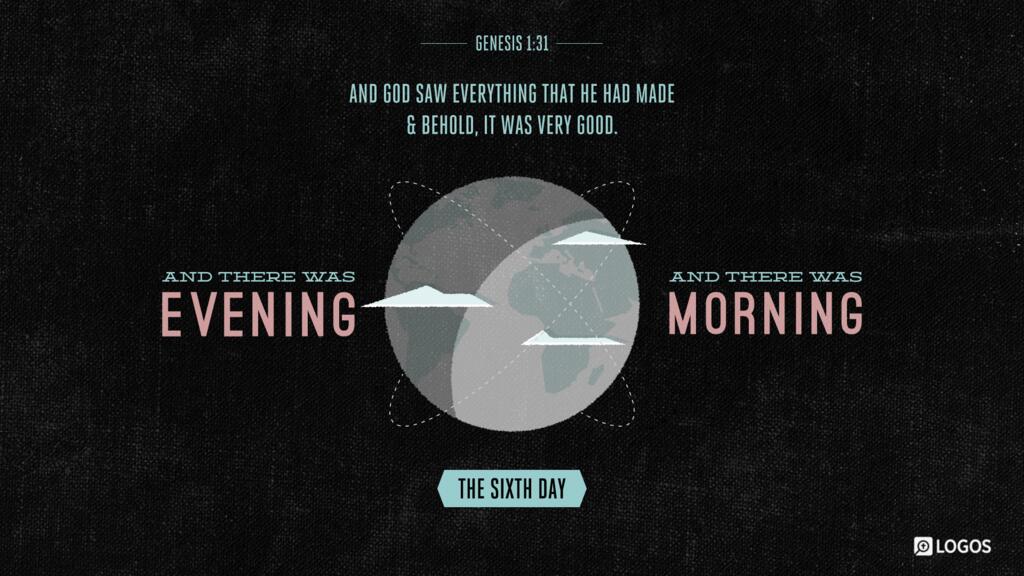
1:31God saw all that he had made—and it was very good!63 There was evening, and there was morning, the sixth day.
2:1The heavens and the earth1 were completed with everything that was in them.22:2By3 the seventh day God finished the work that he had been doing,4 and he ceased5 on the seventh day all the work that he had been doing. 2:3God blessed the seventh day and made it holy6 because on it he ceased all the work that he7 had been doing in creation.8
Footnotes
- 60 The text uses הִנֵּה (hinneh), often archaically translated “behold.” It is often used to express the dramatic present, the immediacy of an event—“Look, this is what I am doing!”
- 61 G. J. Wenham (Genesis [], 1:) points out that there is nothing in the passage that prohibits the man and the woman from eating meat. He suggests that eating meat came after the fall. Gen 9:3 may then ratify the postfall practice of eating meat rather than inaugurate the practice, as is often understood.
- 62 The phrase “I give” is not in the Hebrew text but has been supplied in the translation for clarification.
- 63 The Hebrew text again uses הִנֵּה (hinneh) for the sake of vividness. It is a particle that goes with the gesture of pointing, calling attention to something.
- 1 See the note on the phrase “the heavens and the earth” in .
- 2 Heb “and all the host of them.” Here the “host” refers to all the entities and creatures that God created to populate the world.
- 3 Heb “on/in the seventh day.”
- 4 Heb “his work which he did [or “made”].”
- 5 The Hebrew term שָׁבַּת (shabbat) can be translated “to rest” (“and he rested”) but it basically means “to cease.” This is not a rest from exhaustion; it is the cessation of the work of creation.
- 6 The verb is usually translated “and sanctified it.” The Piel verb קִדֵּשׁ (qiddesh) means “to make something holy; to set something apart; to distinguish it.” On the literal level the phrase means essentially that God made this day different. But within the context of the Law, it means that the day belonged to God; it was for rest from ordinary labor, worship, and spiritual service. The day belonged to God.
- 7 Heb “God.” The pronoun (“he”) has been employed in the translation for stylistic reasons.
- 8 Heb “for on it he ceased from all his work which God created to make.” The last infinitive construct and the verb before it form a verbal hendiadys, the infinitive becoming the modifier—“which God creatively made,” or “which God made in his creating.”
The NET Bible First Edition, Copyright 1996-2005 by Biblical Studies Press