Ezekiel 36:24–38
The NET BibleOther versions
English
- NET The NET Bible
- DARBY 1890 Darby Bible
- ASV American Standard Version
- AV 1873 The Cambridge Paragraph Bible of the Authorized English Version
- CSB Christian Standard Bible
- D-R Douay-Rheims Bible
- ESV English Standard Version
- GW GOD’S WORD Translation
- GNB Good News Translation
- HCSB The Holman Christian Standard Bible
- KJV 1900 King James Version
- LSB Legacy Standard Bible
- LEB The Lexham English Bible
- MSG The Message: The Bible in Contemporary Language
- NASB95 New American Standard Bible (1995)
- NCV New Century Version
- NIrV New International Reader’s Version (1998)
- NIV New International Version (2011)
- NKJV The New King James Version
- NLT New Living Translation
- NRSVue New Revised Standard Version: Updated Edition
- RSV The Revised Standard Version
- RSVCE The Revised Standard Version, Catholic Edition
- YLT Young’s Literal Translation
Arabic
Czech
French
German
Hebrew
Hungarian
Italian
Korean
Latin
Portuguese
Russian
Simplified Chinese
Spanish
Traditional Chinese
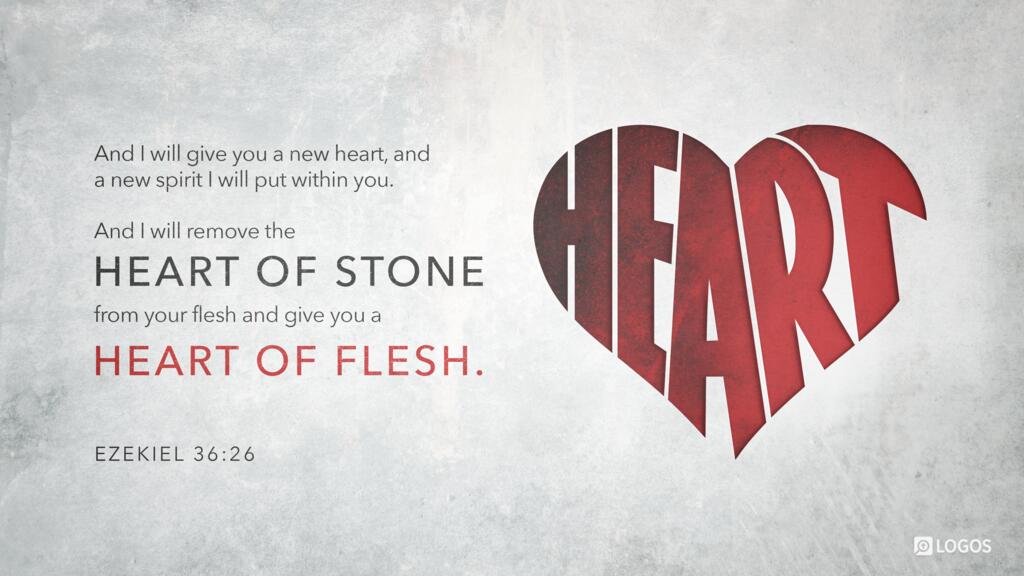
36:24“ ‘I will take you from the nations and gather you from all the countries; then I will bring you to your land. 36:25I will sprinkle you with pure water17 and you will be clean from all your impurities. I will purify you from all your idols. 36:26I will give you a new heart, and I will put a new spirit within you. I will remove the heart of stone18 from your body and give you a heart of flesh.1936:27I will put my Spirit within you;20 I will take the initiative and you will obey my statutes21 and carefully observe my regulations.2236:28Then you will live in the land I gave to your fathers; you will be my people, and I will be your God.2336:29I will save you from all your uncleanness. I will call for the grain and multiply it; I will not bring a famine on you. 36:30I will multiply the fruit of the trees and the produce of the fields, so that you will never again suffer the disgrace of famine among the nations. 36:31Then you will remember your evil behavior24 and your deeds which were not good; you will loathe yourselves on account of your sins and your abominable deeds. 36:32Understand that25 it is not for your sake I am about to act, declares the sovereign Lord. Be ashamed and embarrassed by your behavior, O house of Israel.
36:33“ ‘This is what the sovereign Lord says: In the day I cleanse you from all your sins, I will populate the cities and the ruins will be rebuilt. 36:34The desolate land will be plowed, instead of being desolate in the sight of everyone who passes by. 36:35They will say, “This desolate land has become like the garden of Eden; the ruined, desolate, and destroyed cities are now fortified and inhabited.” 36:36Then the nations which remain around you will know that I, the Lord, have rebuilt the ruins and replanted what was desolate. I, the Lord, have spoken—and I will do it!’
36:37“This is what the sovereign Lord says: I will allow the house of Israel to ask me to do this for them:26 I will multiply their people like sheep.2736:38Like the sheep for offerings, like the sheep of Jerusalem28 during her appointed feasts, so will the ruined cities be filled with flocks of people. Then they will know that I am the Lord.”
Footnotes
- 17 The Lord here uses a metaphor from the realm of ritual purification. For the use of water in ritual cleansing, see Exod 30:19–20; Lev 14:51; Num 19:18; Heb 10:22.
- 18 That is, a heart which symbolizes a will that is stubborn and unresponsive (see 1 Sam 25:37). In Rabbinic literature a “stone” was associated with an evil inclination ( Sukkah 52a).
- 19 That is, a heart which symbolizes a will that is responsive and obedient to God.
- 20 Or “in the midst of you.” The word “you” is plural.
- 21 Heb “and I will do that which in my statutes you will walk.” The awkward syntax (verb “to do, act” + accusative sign + relative clause + prepositional phrase + second person verb) is unique, though Eccl 3:14 contains a similar construction. In the last line of that verse we read that “God acts so that (relative pronoun) they fear before him.” However, unlike Ezek 36:27, the statement has no accusative sign before the relative pronoun.
- 22 Heb “and my laws you will guard and you will do them.” Jer 31:31–34 is parallel to this passage.
- 23 This promise reflects the ancient covenantal ideal (see Exod 6:7).
- 24 Heb “ways.”
- 25 Heb “Let it be known.”
- 26 The Niphal verb may have a tolerative function here, “Again (for) this I will allow myself to be sought by the house of Israel to act for them.” Or it may be reflexive: “I will reveal myself to the house of Israel by doing this also.”
- 27 Heb “I will multiply them like sheep, human(s).”
- 28 For location see ; ; ; ; ; ; ; ; .
The NET Bible First Edition, Copyright 1996-2005 by Biblical Studies Press