Exodus 27:21–28:1
The NET BibleOther versions
English
- NET The NET Bible
- DARBY 1890 Darby Bible
- ASV American Standard Version
- AV 1873 The Cambridge Paragraph Bible of the Authorized English Version
- CSB Christian Standard Bible
- D-R Douay-Rheims Bible
- ESV English Standard Version
- GW GOD’S WORD Translation
- GNB Good News Translation
- HCSB The Holman Christian Standard Bible
- KJV 1900 King James Version
- LSB Legacy Standard Bible
- LEB The Lexham English Bible
- MSG The Message: The Bible in Contemporary Language
- NASB95 New American Standard Bible (1995)
- NCV New Century Version
- NIrV New International Reader’s Version (1998)
- NIV New International Version (2011)
- NKJV The New King James Version
- NLT New Living Translation
- NRSVue New Revised Standard Version: Updated Edition
- RSV The Revised Standard Version
- RSVCE The Revised Standard Version, Catholic Edition
- YLT Young’s Literal Translation
Arabic
Czech
French
German
Hebrew
Hungarian
Italian
Korean
Latin
Portuguese
Russian
Simplified Chinese
Spanish
Traditional Chinese
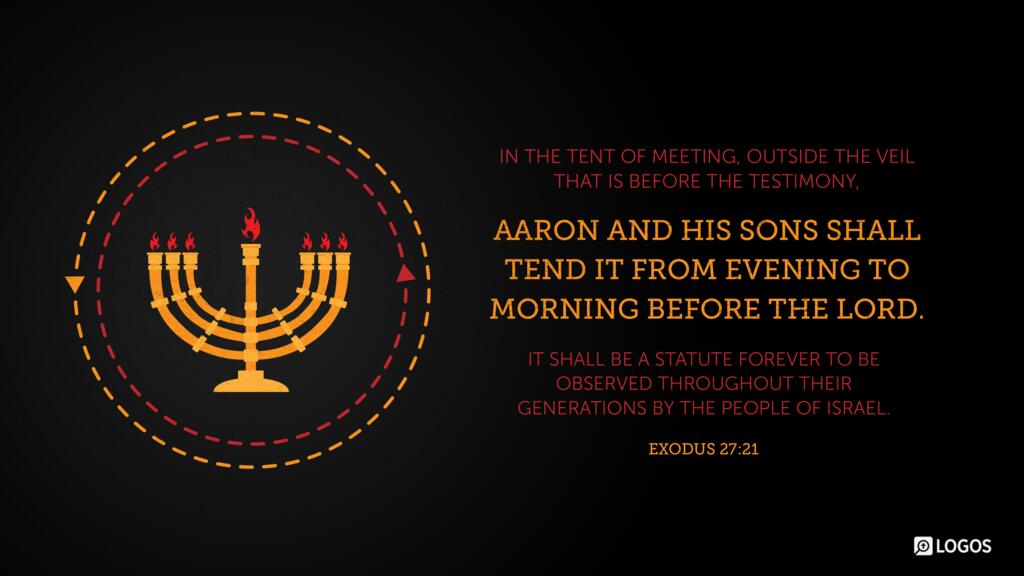
27:21In the tent of meeting42 outside the curtain that is before the testimony, Aaron and his sons are to arrange it from evening43 to morning before the Lord. This is to be a lasting ordinance among the Israelites for generations to come.44
The Clothing of the Priests
28:11 “And you, bring near2 to you your brother Aaron and his sons with him from among the Israelites, so that they may minister as my priests3—Aaron, Nadab and Abihu, Eleazar and Ithamar, Aaron’s sons.
Footnotes
- 42 The has mistakenly rendered this name “the tent of the testimony.”
- 43 The lamps were to be removed in the morning so that the wicks could be trimmed and the oil replenished (30:7) and then lit every evening to burn through the night.
- 44 This is the first of several sections of priestly duties. The point is a simple one here: those who lead the worship use the offerings of the people to ensure that access to God is illumined regularly. The NT will make much of the symbolism of light.
- 1 Some modern scholars find this and the next chapter too elaborate for the wilderness experience. To most of them this reflects the later Zadokite priesthood of the writer’s (P’s) day that was referred to Mosaic legislation for authentication. But there is no compelling reason why this should be late; it is put late because it is assumed to be P, and that is assumed to be late. But both assumptions are unwarranted. This lengthy chapter could be divided this way: instructions for preparing the garments (1–5), details of the apparel (6–39), and a warning against deviating from these (40–43). The subject matter of the first part is that God requires that his chosen ministers reflect his holy nature; the point of the second part is that God requires his ministers to be prepared to fulfill the tasks of the ministry, and the subject matter of the third part is that God warns all his ministers to safeguard the holiness of their service.
- 2 The verb is the Hiphil imperative of the root קָרַב (qarav, “to draw near”). In the present stem the word has religious significance, namely, to present something to God, like an offering.
- 3 This entire clause is a translation of the Hebrew לְכַהֲנוֹ־לִי (lékhahano-li, “that he might be a priest to me”), but the form is unusual. The word means “to be a priest” or “to act as a priest.” The etymology of the word for priest, כֹּהֵן (kohen), is uncertain.
The NET Bible First Edition, Copyright 1996-2005 by Biblical Studies Press