Deuteronomy 6:5
The NET BibleOther versions
English
- NET The NET Bible
- DARBY 1890 Darby Bible
- ASV American Standard Version
- AV 1873 The Cambridge Paragraph Bible of the Authorized English Version
- CSB Christian Standard Bible
- D-R Douay-Rheims Bible
- ESV English Standard Version
- GW GOD’S WORD Translation
- GNB Good News Translation
- HCSB The Holman Christian Standard Bible
- KJV 1900 King James Version
- LSB Legacy Standard Bible
- LEB The Lexham English Bible
- MSG The Message: The Bible in Contemporary Language
- NASB95 New American Standard Bible (1995)
- NCV New Century Version
- NIrV New International Reader’s Version (1998)
- NIV New International Version (2011)
- NKJV The New King James Version
- NLT New Living Translation
- NRSVue New Revised Standard Version: Updated Edition
- RSV The Revised Standard Version
- RSVCE The Revised Standard Version, Catholic Edition
- YLT Young’s Literal Translation
Arabic
Czech
French
German
Hebrew
Hungarian
Italian
Korean
Latin
Portuguese
Russian
Simplified Chinese
Spanish
Traditional Chinese
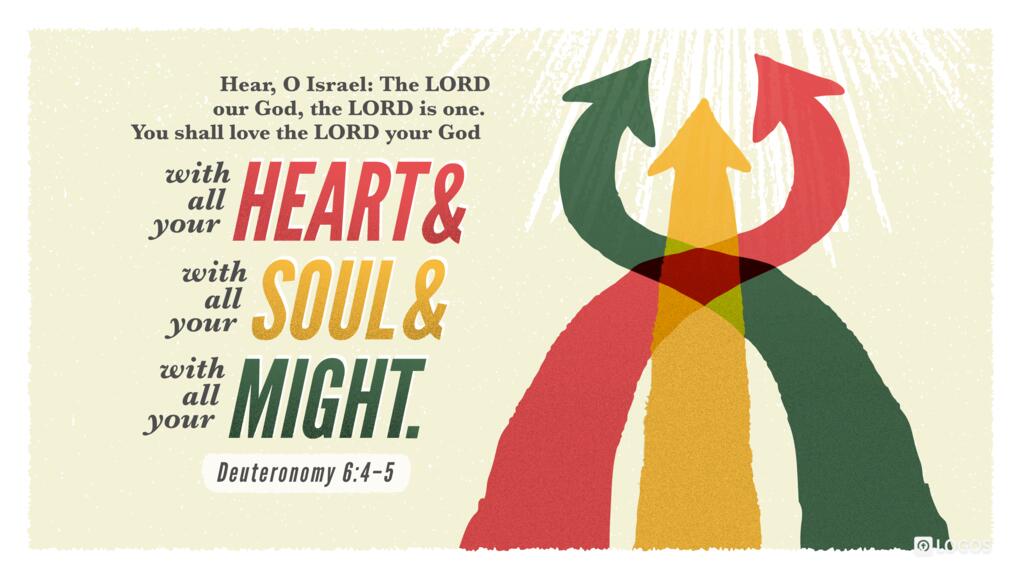
6:5You must love8 the Lord your God with your whole mind,9 your whole being,10 and all your strength.11
Footnotes
- 8 The verb אָהַב (’ahav, “to love”) in this setting communicates not so much an emotional idea as one of covenant commitment. To love the Lord is to be absolutely loyal and obedient to him in every respect, a truth Jesus himself taught (cf. John 14:15). See also the note on the word “loved” in .
- 9 Heb “heart.” In OT physiology the heart (לֵב, לֵבָב; levav, lev) was considered the seat of the mind or intellect, so that one could think with one’s heart. See A. Luc, 2:.
- 10 Heb “soul”; “being.” Contrary to Hellenistic ideas of a soul that is discrete and separate from the body and spirit, OT anthropology equated the “soul” (נֶפֶשׁ, nefesh) with the person himself. It is therefore best in most cases to translate נֶפֶשׁ (nefesh) as “being” or the like. See H. W. Wolff, Anthropology of the Old Testament, 10–25; D. Fredericks, 3:.
- 11 For NT variations on the Shema see Matt 22:37–39; Mark 12:29–30; Luke 10:27.
The NET Bible First Edition, Copyright 1996-2005 by Biblical Studies Press
In other versions
ESVEnglish Standard Version
You shall love the Lord your God with all your heart and with all your soul and with all your might.
Copyright 2001 Crossway Bibles
NIVNew International Version (2011)
Love the Lord your God with all your heart and with all your soul and with all your strength.
Copyright 1973, 1978, 1984, 2011 Biblica, Inc.
CSBChristian Standard Bible
Love the Lord your God with all your heart, with all your soul, and with all your strength.
Copyright 2017 Holman Bible Publishers
NLTNew Living Translation
And you must love the Lord your God with all your heart, all your soul, and all your strength.
Holy Bible, New Living Translation, copyright © 1996, 2004, 2015 by Tyndale House Foundation. Used by permission of Tyndale House Publishers. All rights reserved.
LEBThe Lexham English Bible
And you shall love Yahweh your God with all of your heart and with all of your soul and with all of your might.
Copyright 2012 Lexham Press
KJV 1900King James Version
And thou shalt love the Lord thy God with all thine heart, and with all thy soul, and with all thy might.
Public Domain