Acts 10:34–43
The NET BibleOther versions
English
- NET The NET Bible
- DARBY 1890 Darby Bible
- ASV American Standard Version
- AV 1873 The Cambridge Paragraph Bible of the Authorized English Version
- CSB Christian Standard Bible
- D-R Douay-Rheims Bible
- ESV English Standard Version
- GW GOD’S WORD Translation
- GNB Good News Translation
- HCSB The Holman Christian Standard Bible
- KJV 1900 King James Version
- LSB Legacy Standard Bible
- LEB The Lexham English Bible
- MSG The Message: The Bible in Contemporary Language
- NASB95 New American Standard Bible (1995)
- NCV New Century Version
- NIrV New International Reader’s Version (1998)
- NIV New International Version (2011)
- NKJV The New King James Version
- NLT New Living Translation
- NRSVue New Revised Standard Version: Updated Edition
- RSV The Revised Standard Version
- RSVCE The Revised Standard Version, Catholic Edition
- YLT Young’s Literal Translation
Arabic
Czech
French
German
Greek
Hungarian
Italian
Korean
Latin
Portuguese
Russian
Simplified Chinese
Spanish
Traditional Chinese
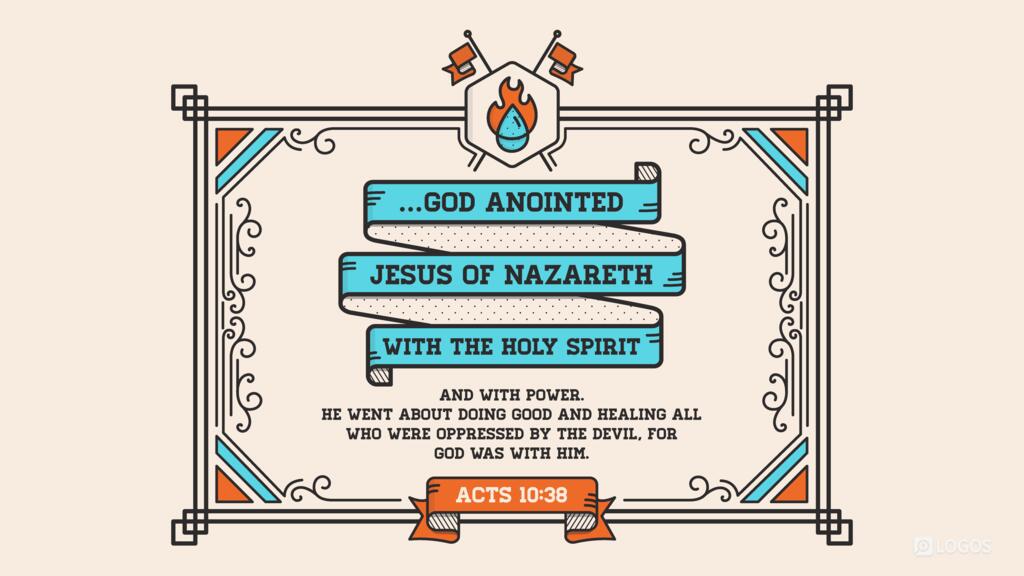
10:34Then Peter started speaking:90 “I now truly understand that God does not show favoritism in dealing with people,9110:35but in every nation92 the person who fears him93 and does what is right94 is welcomed before him. 10:36You know95 the message96 he sent to the people97 of Israel, proclaiming the good news of peace98 through99 Jesus Christ100 (he is Lord101 of all)—10:37you know what happened throughout Judea, beginning from Galilee after the baptism that John announced:10210:38with respect to Jesus from Nazareth,103 that104 God anointed him with the Holy Spirit and with power. He105 went around doing good and healing all who were oppressed by the devil,106 because God was with him.10710:39We108 are witnesses of all the things he did both in Judea109 and in Jerusalem.110 They111 killed him by hanging him on a tree,11210:40but113 God raised him up on the third day and caused him to be seen,11410:41not by all the people, but by us, the witnesses God had already chosen,115 who ate and drank116 with him after he rose from the dead. 10:42He117 commanded us to preach to the people and to warn118 them119 that he is the one120 appointed121 by God as judge122 of the living and the dead. 10:43About him all the prophets testify,123 that everyone who believes in him receives forgiveness of sins124 through his name.”
Footnotes
- 90 Grk “Opening his mouth Peter said” (a Semitic idiom for beginning to speak in a somewhat formal manner). The participle ἀνοίξας (anoixas) has been translated as a finite verb due to requirements of contemporary English style.
- 91 Grk “God is not one who is a respecter of persons,” that is, “God is not one to show partiality” (cf. προσωπολήμπτης). L&N 88.239 translates this verse “I realize that God does not show favoritism (in dealing with people).” The underlying Hebrew idiom includes the personal element (“respecter of persons”) so the phrase “in dealing with people” is included in the present translation. It fits very well with the following context and serves to emphasize the relational component of God’s lack of partiality. The latter is a major theme in the NT: Rom 2:11; Eph 2:11–22; Col 3:25; Jas 2:1; 1 Pet 1:17. This was the lesson of Peter’s vision.
- 93 Or “shows reverence for him.”
- 94 Grk “works righteousness”; the translation “does what is right” for this phrase in this verse is given by L&N 25.85. Note how faith and response are linked here by the phrase and does what is right.
- 95 The subject and verb (“you know”) do not actually occur until the following verse, but have been repeated here because of the requirements of English word order.
- 96 Grk “the word.”
- 97 Grk “to the sons.”
- 98 Peace is a key OT concept: Isa 52:7; Nah 1:15; also for Luke: Luke 1:79; 2:14; Acts 9:31. See also the similar phrase in Eph 2:17.
- 99 Or “by.”
- 100 Or “Messiah”; both “Christ” (Greek) and “Messiah” (Hebrew and Aramaic) mean “one who has been anointed.”
- 101 He is Lord of all. Though a parenthetical remark, this is the theological key to the speech. Jesus is Lord of all, so the gospel can go to all. The rest of the speech proclaims Jesus’ authority.
- 102 Or “proclaimed.”
- 103 The somewhat awkward naming of Jesus as from Nazareth here is actually emphatic. He is the key subject of these key events.
- 104 Or “how.” The use of ὡς (hōs) as an equivalent to ὅτι (hoti) to introduce indirect or even direct discourse is well documented. ὡς 5 lists Acts 10:28 in this category.
- 105 Grk “power, who.” The relative pronoun was replaced by the pronoun “he,” and a new sentence was begun in the translation at this point to improve the English style, due to the length of the sentence in Greek.
- 106 The translation “healing all who were oppressed by the devil” is given in L&N 22.22. All who were oppressed by the devil. Note how healing is tied to the cosmic battle present in creation. Christ’s power overcomes the devil and his forces, which seek to destroy humanity.
- 108 Grk “And we.” Because of the difference between Greek style, which often begins sentences or clauses with “and,” and English style, which generally does not, καί (kai) has not been translated here.
- 109 Grk “the land of the Jews,” but this is similar to the phrase used as the name of the province of Judea in 1 Macc 8:3 (see χώρα 2.b).
- 110 For location see ; ; ; ; ; ; ; ; .
- 111 Grk “in Jerusalem, whom they killed.” The relative pronoun was replaced by the pronoun “him” and a new sentence was begun in the translation at this point to improve the English style, due to the length of the sentence in Greek.
- 112 Or “by crucifying him” (“hang on a tree” is by the time of the 1st century an idiom for crucifixion). The allusion is to the judgment against Jesus as a rebellious figure, appealing to the language of Deut 21:23. The Jewish leadership has badly “misjudged” Jesus.
- 113 The conjunction “but” is not in the Greek text, but the contrast is clearly implied in the context. This is technically asyndeton, or lack of a connective, in Greek.
- 114 Grk “and granted that he should become visible.” The literal Greek idiom is somewhat awkward in English. L&N 24.22 offers the translation “caused him to be seen” for this verse.
- 115 Or “the witnesses God had previously chosen.” See Acts 1:8.
- 116 Ate and drank. See Luke 24:35–49.
- 117 Grk “and he.” Because of the difference between Greek style, which often begins sentences or clauses with “and,” and English style, which generally does not, καί (kai) has not been translated here.
- 118 The verb διαμαρτύρομαι (diamarturomai) can mean “warn,” and such a meaning is highly probable in this context where a reference to the judgment of both the living and the dead is present. The more general meaning “to testify solemnly” does not capture this nuance.
- 119 The word “them” is not in the Greek text, but is implied. Direct objects were often omitted in Greek when clear from the context, but must be supplied for the modern English reader.
- 120 Grk “that this one is the one,” but this is awkward in English and has been simplified to “that he is the one.”
- 121 Or “designated.” ὁρίζω 2.b has “the one appointed by God as judge” for this phrase.
- 122 Jesus has divine authority as judge over the living and the dead: Acts 17:26–31; Rom 14:9; 1 Thess 5:9–10; 2 Tim 4:1; 1 Pet 4:5.
- 123 Or “All the prophets testify about him.” Although modern English translations tend to place “about him” after “testify” (so , ) the phrase “about him” has been left at the beginning of v. 43 for emphatic reasons.
- 124 Forgiveness of sins. See Luke 24:47; also Acts 14:23; 19:4; 9:42; 11:17; 16:31. The gospel is present in the prophetic promise, Rom 1:1–7. The message is in continuity with the ancient hope.
Cross references
- 92 See Luke 24:47.
- 107 See Acts 7:9.
The NET Bible First Edition, Copyright 1996-2005 by Biblical Studies Press