2 Peter 3:11–13
The NET BibleOther versions
English
- NET The NET Bible
- DARBY 1890 Darby Bible
- ASV American Standard Version
- AV 1873 The Cambridge Paragraph Bible of the Authorized English Version
- CSB Christian Standard Bible
- D-R Douay-Rheims Bible
- ESV English Standard Version
- GW GOD’S WORD Translation
- GNB Good News Translation
- HCSB The Holman Christian Standard Bible
- KJV 1900 King James Version
- LSB Legacy Standard Bible
- LEB The Lexham English Bible
- MSG The Message: The Bible in Contemporary Language
- NASB95 New American Standard Bible (1995)
- NCV New Century Version
- NIrV New International Reader’s Version (1998)
- NIV New International Version (2011)
- NKJV The New King James Version
- NLT New Living Translation
- NRSVue New Revised Standard Version: Updated Edition
- RSV The Revised Standard Version
- RSVCE The Revised Standard Version, Catholic Edition
- YLT Young’s Literal Translation
Arabic
Czech
French
German
Greek
Hungarian
Italian
Korean
Latin
Portuguese
Russian
Simplified Chinese
Spanish
Traditional Chinese
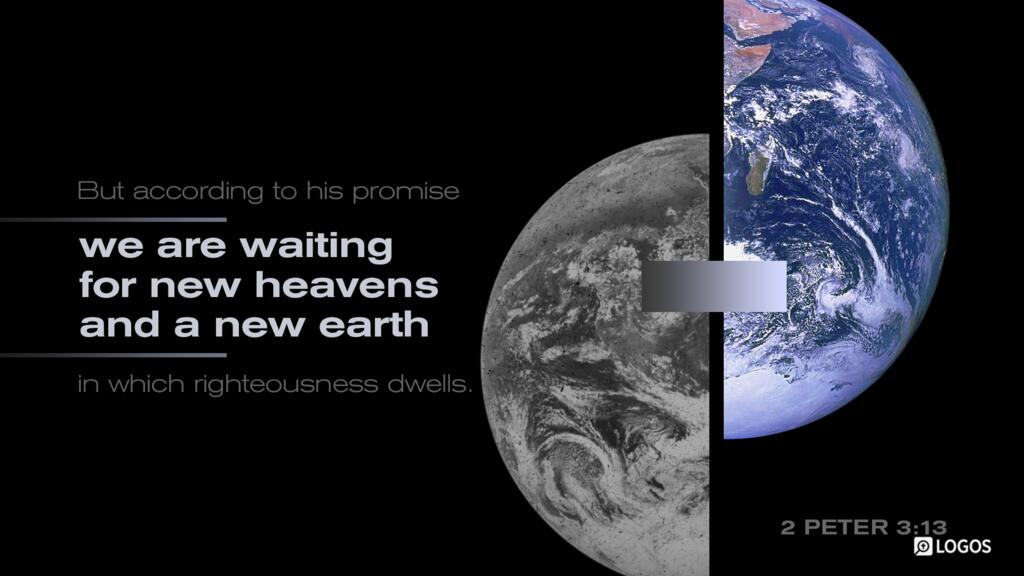
3:11Since all these things are to melt away35 in this manner,36 what sort of people must we37 be, conducting our lives in holiness and godliness,383:12while waiting for and hastening39 the coming of the day of God?40 Because of this day,41 the heavens will be burned up and42 dissolve, and the celestial bodies43 will melt away in a blaze!443:13But, according to his promise, we are waiting for45 new heavens and a new earth, in which46 righteousness truly resides.47
Footnotes
- 35 Grk “all these things thus being dissolved.”
- 36 Or “thus.”
- 37 Most have a pronoun with the infinitive—either ὑμᾶς (humas, “you”; found in A C[*] P Ψ 048vid 33 1739 𝔐, as well as the corrector of 𝔓72 and second corrector of א), ἡμᾶς (hēmas, “we”; read by א* 630 2464 al), or ἑαυτούς (heautous, “[you your]selves/[we our]selves,” read by 1243). But the shorter reading (with no pronoun) has the support of 𝔓72*,74vid B . Though slim, the evidence for the omission is nevertheless the earliest. Further, the addition of some pronoun, especially the second person pronoun, seems to be a clarifying variant. It would be difficult to explain the pronoun’s absence in some witnesses if the pronoun were original. That three different pronouns have shown up in the is testimony for the omission. Thus, on external and internal grounds, the omission is preferred. For English style requirements, however, some pronoun has to be added. has ὑμᾶς in brackets, indicating doubt as to its authenticity. Or “you.”
- 38 Grk “in holy conduct and godliness.”
- 39 Or possibly, “striving for,” but the meaning “hasten” for σπουδάζω (spoudazō) is normative in Jewish apocalyptic literature (in which the coming of the Messiah/the end is anticipated). Such a hastening is not an arm-twisting of the divine volition, but a response by believers that has been decreed by God.
- 40 The coming of the day of God. Peter elsewhere describes the coming or parousia as the coming of Christ (cf. 2 Pet 1:16; 3:4). The almost casual exchange between “God” and “Christ” in this little book, and elsewhere in the NT, argues strongly for the deity of Christ (see esp. 1:1).
- 41 Grk “on account of which” (a subordinate relative clause in Greek).
- 42 Grk “being burned up, will dissolve.”
- 43 See note in v. on “celestial bodies.”
- 44 Grk “being burned up” (see v. 10).
- 45 Or possibly, “let us wait for.” The form in Greek (προσδόκωμεν, prosdokōmen) could be either indicative or subjunctive. The present participle in v. 14, however, is best taken causally (“since you are waiting for”), suggesting that the indicative is to be read here.
- 46 The relative pronoun is plural, indicating that the sphere in which righteousness dwells is both the new heavens and the new earth.
- 47 Grk “dwells.” The verb κατοικέω (katoikeō) is an intensive cognate of οἰκέω (oikeō), often with the connotation of “taking up residence,” “settling down,” being at home,” etc. Cf., e.g., Matt 2:23; Acts 17:26; 22:12; Eph 3:17; Col 1:19; 2:9. Hence, the addition of the adverb “truly” is implicit in the connotation of the verb in a context such as this.
The NET Bible First Edition, Copyright 1996-2005 by Biblical Studies Press
In other versions
ESVEnglish Standard Version
Since all these things are thus to be dissolved, what sort of people ought you to be in lives of holiness and godliness, waiting for and hastening the coming of the day of God, because of which the heavens will be set on fire and dissolved, and the heavenly bodies will melt as they burn! But according to his promise we are waiting for new heavens and a new earth in which righteousness dwells.
Copyright 2001 Crossway Bibles
NIVNew International Version (2011)
Since everything will be destroyed in this way, what kind of people ought you to be? You ought to live holy and godly lives as you look forward to the day of God and speed its coming. That day will bring about the destruction of the heavens by fire, and the elements will melt in the heat. But in keeping with his promise we are looking forward to a new heaven and a new earth, where righteousness dwells.
Copyright 1973, 1978, 1984, 2011 Biblica, Inc.
CSBChristian Standard Bible
Since all these things are to be dissolved in this way, it is clear what sort of people you should be in holy conduct and godliness as you wait for the day of God and hasten its coming. Because of that day, the heavens will be dissolved with fire and the elements will melt with heat. But based on his promise, we wait for new heavens and a new earth, where righteousness dwells.
Copyright 2017 Holman Bible Publishers
NLTNew Living Translation
Since everything around us is going to be destroyed like this, what holy and godly lives you should live, looking forward to the day of God and hurrying it along. On that day, he will set the heavens on fire, and the elements will melt away in the flames. But we are looking forward to the new heavens and new earth he has promised, a world filled with God’s righteousness.
Holy Bible, New Living Translation, copyright © 1996, 2004, 2015 by Tyndale House Foundation. Used by permission of Tyndale House Publishers. All rights reserved.
LEBThe Lexham English Bible
Because all these things are being destroyed in this way, what sort of people must you be in holy behavior and godliness, while waiting for and hastening the coming of the day of God, because of which the heavens will be destroyed by being burned up and the celestial bodies will melt as they are consumed by heat! But according to his promise, we are waiting for new heavens and a new earth in which righteousness resides.
Copyright 2012 Lexham Press
KJV 1900King James Version
Seeing then that all these things shall be dissolved, what manner of persons ought ye to be in all holy conversation and godliness, Looking for and hasting unto the coming of the day of God, wherein the heavens being on fire shall be dissolved, and the elements shall melt with fervent heat? Nevertheless we, according to his promise, look for new heavens and a new earth, wherein dwelleth righteousness.
Public Domain