1 Timothy 1:12–17
The NET BibleOther versions
English
- NET The NET Bible
- DARBY 1890 Darby Bible
- ASV American Standard Version
- AV 1873 The Cambridge Paragraph Bible of the Authorized English Version
- CSB Christian Standard Bible
- D-R Douay-Rheims Bible
- ESV English Standard Version
- GW GOD’S WORD Translation
- GNB Good News Translation
- HCSB The Holman Christian Standard Bible
- KJV 1900 King James Version
- LSB Legacy Standard Bible
- LEB The Lexham English Bible
- MSG The Message: The Bible in Contemporary Language
- NASB95 New American Standard Bible (1995)
- NCV New Century Version
- NIrV New International Reader’s Version (1998)
- NIV New International Version (2011)
- NKJV The New King James Version
- NLT New Living Translation
- NRSVue New Revised Standard Version: Updated Edition
- RSV The Revised Standard Version
- RSVCE The Revised Standard Version, Catholic Edition
- YLT Young’s Literal Translation
Arabic
Czech
French
German
Greek
Hungarian
Italian
Korean
Latin
Portuguese
Russian
Simplified Chinese
Spanish
Traditional Chinese
1:12I am grateful to the one who has strengthened me, Christ Jesus our Lord, because he considered me faithful in putting me into ministry, 1:13even though I was formerly a blasphemer and a persecutor, and an arrogant16 man. But I was treated with mercy because I acted ignorantly in unbelief, 1:14and our Lord’s grace was abundant, bringing faith and love in Christ Jesus.171:15This saying18 is trustworthy and deserves full acceptance: “Christ Jesus came into the world to save sinners”—and I am the worst of them!191:16But here is why I was treated with mercy: so that20 in me as the worst,21 Christ Jesus could demonstrate his utmost patience, as an example for those who are going to believe in him for eternal life. 1:17Now to the eternal king,22 immortal, invisible, the only23 God, be honor and glory forever and ever!24 Amen.
Footnotes
- 16 Or “violent,” “cruel.”
- 17 Grk “with faith and love in Christ Jesus.”
- 18 Grk “the saying,” referring to the following citation (see 1 Tim 3:1; 4:9; 2 Tim 2:11; Titus 3:8 for other occurrences of this phrase).
- 19 Grk “of whom I am the first.”
- 20 Grk “but because of this I was treated with mercy, so that …”
- 21 Grk “in me first,” making the connection with the last phrase of v. 15.
- 22 Or more literally, “king of the ages.”
- 23 Most later witnesses (א2 D1 Hc Ψ 1881 𝔐) have “wise” (σόφῳ, sōphō) here (thus, “the only wise God”), while the earlier and better witnesses (א* A D* F G H* 33 1739 lat co) lack this adjective. Although it could be argued that the longer reading is harder since it does not as emphatically affirm monotheism, it is more likely that scribes borrowed σόφῳ from Rom 16:27 where μόνῳ σόφῳ θεῷ (monō sophō theō, “the only wise God”) is textually solid.
- 24 Grk “unto the ages of the ages,” an emphatic way of speaking about eternity in Greek.
The NET Bible First Edition, Copyright 1996-2005 by Biblical Studies Press
In other versions
ESVEnglish Standard Version
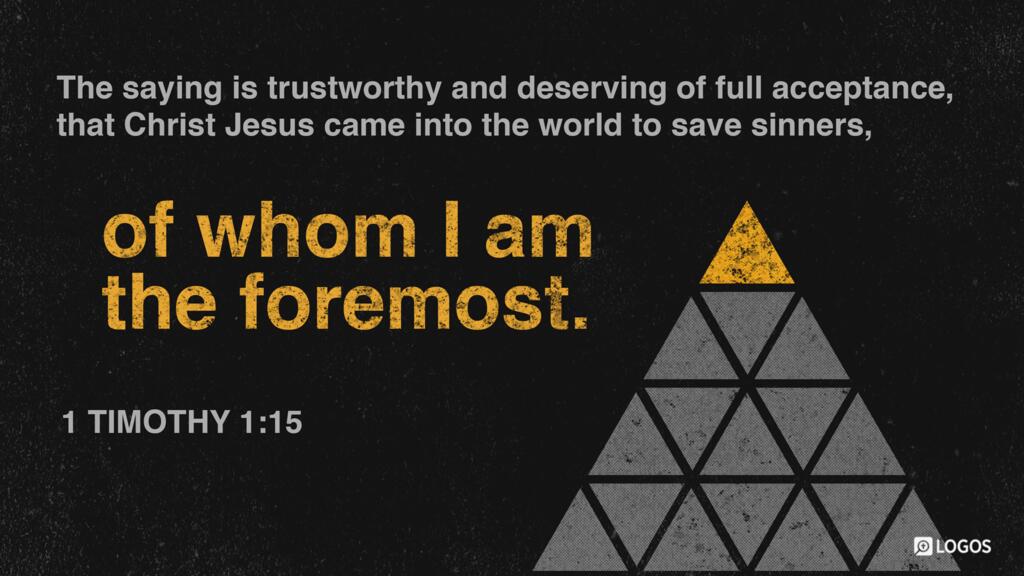
I thank him who has given me strength, Christ Jesus our Lord, because he judged me faithful, appointing me to his service, though formerly I was a blasphemer, persecutor, and insolent opponent. But I received mercy because I had acted ignorantly in unbelief, and the grace of our Lord overflowed for me with the faith and love that are in Christ Jesus. The saying is trustworthy and deserving of full acceptance, that Christ Jesus came into the world to save sinners, of whom I am the foremost. But I received mercy for this reason, that in me, as the foremost, Jesus Christ might display his perfect patience as an example to those who were to believe in him for eternal life. To the King of the ages, immortal, invisible, the only God, be honor and glory forever and ever. Amen.
Copyright 2001 Crossway Bibles
NIVNew International Version (2011)
I thank Christ Jesus our Lord, who has given me strength, that he considered me trustworthy, appointing me to his service. Even though I was once a blasphemer and a persecutor and a violent man, I was shown mercy because I acted in ignorance and unbelief. The grace of our Lord was poured out on me abundantly, along with the faith and love that are in Christ Jesus.
Here is a trustworthy saying that deserves full acceptance: Christ Jesus came into the world to save sinners—of whom I am the worst. But for that very reason I was shown mercy so that in me, the worst of sinners, Christ Jesus might display his immense patience as an example for those who would believe in him and receive eternal life. Now to the King eternal, immortal, invisible, the only God, be honor and glory for ever and ever. Amen.
Copyright 1973, 1978, 1984, 2011 Biblica, Inc.
CSBChristian Standard Bible
I give thanks to Christ Jesus our Lord who has strengthened me, because he considered me faithful, appointing me to the ministry—even though I was formerly a blasphemer, a persecutor, and an arrogant man. But I received mercy because I acted out of ignorance in unbelief, and the grace of our Lord overflowed, along with the faith and love that are in Christ Jesus. This saying is trustworthy and deserving of full acceptance: “Christ Jesus came into the world to save sinners”—and I am the worst of them. But I received mercy for this reason, so that in me, the worst of them, Christ Jesus might demonstrate his extraordinary patience as an example to those who would believe in him for eternal life. Now to the King eternal, immortal, invisible, the only God, be honor and glory forever and ever. Amen.
Copyright 2017 Holman Bible Publishers
NLTNew Living Translation
I thank Christ Jesus our Lord, who has given me strength to do his work. He considered me trustworthy and appointed me to serve him, even though I used to blaspheme the name of Christ. In my insolence, I persecuted his people. But God had mercy on me because I did it in ignorance and unbelief. Oh, how generous and gracious our Lord was! He filled me with the faith and love that come from Christ Jesus.
This is a trustworthy saying, and everyone should accept it: “Christ Jesus came into the world to save sinners”—and I am the worst of them all. But God had mercy on me so that Christ Jesus could use me as a prime example of his great patience with even the worst sinners. Then others will realize that they, too, can believe in him and receive eternal life. All honor and glory to God forever and ever! He is the eternal King, the unseen one who never dies; he alone is God. Amen.
Holy Bible, New Living Translation, copyright © 1996, 2004, 2015 by Tyndale House Foundation. Used by permission of Tyndale House Publishers. All rights reserved.
LEBThe Lexham English Bible
I give thanks to the one who strengthens me, Christ Jesus our Lord, because he considered me faithful, placing me into ministry, although I was formerly a blasphemer and a persecutor and a violent man, but I was shown mercy because I acted ignorantly in unbelief, and the grace of our Lord abounded with the faith and love that are in Christ Jesus. The saying is trustworthy and worthy of all acceptance: Christ Jesus came into the world to save sinners, of whom I am the foremost. But because of this I was shown mercy, in order that in me foremost, Christ Jesus might demonstrate his total patience, for an example for those who are going to believe in him for eternal life. Now to the King of the ages, immortal, invisible, to the only God, be honor and glory forever and ever. Amen.
Copyright 2012 Lexham Press
KJV 1900King James Version
And I thank Christ Jesus our Lord, who hath enabled me, for that he counted me faithful, putting me into the ministry; Who was before a blasphemer, and a persecutor, and injurious: but I obtained mercy, because I did it ignorantly in unbelief. And the grace of our Lord was exceeding abundant with faith and love which is in Christ Jesus. This is a faithful saying, and worthy of all acceptation, that Christ Jesus came into the world to save sinners; of whom I am chief. Howbeit for this cause I obtained mercy, that in me first Jesus Christ might shew forth all longsuffering, for a pattern to them which should hereafter believe on him to life everlasting. Now unto the King eternal, immortal, invisible, the only wise God, be honour and glory for ever and ever. Amen.
Public Domain