1 Samuel 15:20–28
The NET BibleOther versions
English
- NET The NET Bible
- DARBY 1890 Darby Bible
- ASV American Standard Version
- AV 1873 The Cambridge Paragraph Bible of the Authorized English Version
- CSB Christian Standard Bible
- D-R Douay-Rheims Bible
- ESV English Standard Version
- GW GOD’S WORD Translation
- GNB Good News Translation
- HCSB The Holman Christian Standard Bible
- KJV 1900 King James Version
- LSB Legacy Standard Bible
- LEB The Lexham English Bible
- MSG The Message: The Bible in Contemporary Language
- NASB95 New American Standard Bible (1995)
- NCV New Century Version
- NIrV New International Reader’s Version (1998)
- NIV New International Version (2011)
- NKJV The New King James Version
- NLT New Living Translation
- NRSVue New Revised Standard Version: Updated Edition
- RSV The Revised Standard Version
- RSVCE The Revised Standard Version, Catholic Edition
- YLT Young’s Literal Translation
Arabic
Czech
French
German
Hebrew
Hungarian
Italian
Korean
Latin
Portuguese
Russian
Simplified Chinese
Spanish
Traditional Chinese
15:20Then Saul said to Samuel, “But I have obeyed29 the Lord! I went on the campaign30 the Lord sent me on. I brought back King Agag of the Amalekites after exterminating the Amalekites. 15:21But the army took from the plunder some of the sheep and cattle—the best of what was to be slaughtered—to sacrifice to the Lord your God in Gilgal.”
15:22Then Samuel said,
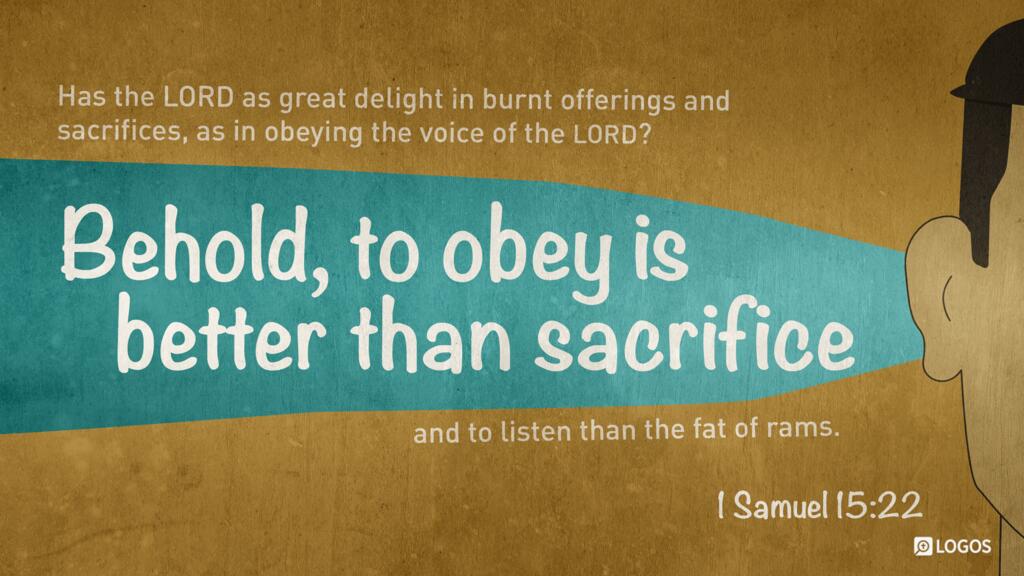
“Does the Lord take pleasure in burnt offerings and sacrifices
as much as he does in obedience?31
Certainly,32 obedience33 is better than sacrifice;
paying attention is better than34 the fat of rams.
15:23For rebellion is like the sin of divination,
and presumption is like the evil of idolatry.
Because you have rejected the word of the Lord,
he has rejected you as35 king.”
15:24Then Saul said to Samuel, “I have sinned, for I have disobeyed what the Lord commanded36 and what you said as well.37 For I was afraid of the army, and I followed their wishes.3815:25Now please forgive my sin! Go back with me so I can worship39 the Lord.”
15:26Samuel said to Saul, “I will not go back with you, for you have rejected the word of the Lord, and the Lord has rejected you from being king over Israel!”
15:27When Samuel turned to leave, Saul40 grabbed the edge of his robe and it tore. 15:28Samuel said to him, “The Lord has torn the kingdom of Israel from you this day and has given it to one of your colleagues who is better than you!
Footnotes
- 29 Heb “listened to the voice of the Lord.”
- 30 Heb “journey.”
- 31 Heb “as [in] listening to the voice of the Lord.”
- 32 Heb “look.”
- 33 Heb “listening.”
- 34 The expression “is better” is understood here by ellipsis (see the immediately preceding statement).
- 35 Or “from [being].”
- 36 Heb “the mouth of the Lord.”
- 37 Heb “and your words.”
- 38 Heb “and I listened to their voice.”
- 39 Following the imperative, the cohortative with the prefixed conjunction indicates purpose/result.
- 40 Heb “he,” but Saul is clearly the referent. A Qumran and the include the name “Saul” here.
The NET Bible First Edition, Copyright 1996-2005 by Biblical Studies Press