1 Kings 17:8–24
The NET BibleOther versions
English
- NET The NET Bible
- DARBY 1890 Darby Bible
- ASV American Standard Version
- AV 1873 The Cambridge Paragraph Bible of the Authorized English Version
- CSB Christian Standard Bible
- D-R Douay-Rheims Bible
- ESV English Standard Version
- GW GOD’S WORD Translation
- GNB Good News Translation
- HCSB The Holman Christian Standard Bible
- KJV 1900 King James Version
- LSB Legacy Standard Bible
- LEB The Lexham English Bible
- MSG The Message: The Bible in Contemporary Language
- NASB95 New American Standard Bible (1995)
- NCV New Century Version
- NIrV New International Reader’s Version (1998)
- NIV New International Version (2011)
- NKJV The New King James Version
- NLT New Living Translation
- NRSVue New Revised Standard Version: Updated Edition
- RSV The Revised Standard Version
- RSVCE The Revised Standard Version, Catholic Edition
- YLT Young’s Literal Translation
Arabic
Czech
French
German
Hebrew
Hungarian
Italian
Korean
Latin
Portuguese
Russian
Simplified Chinese
Spanish
Traditional Chinese
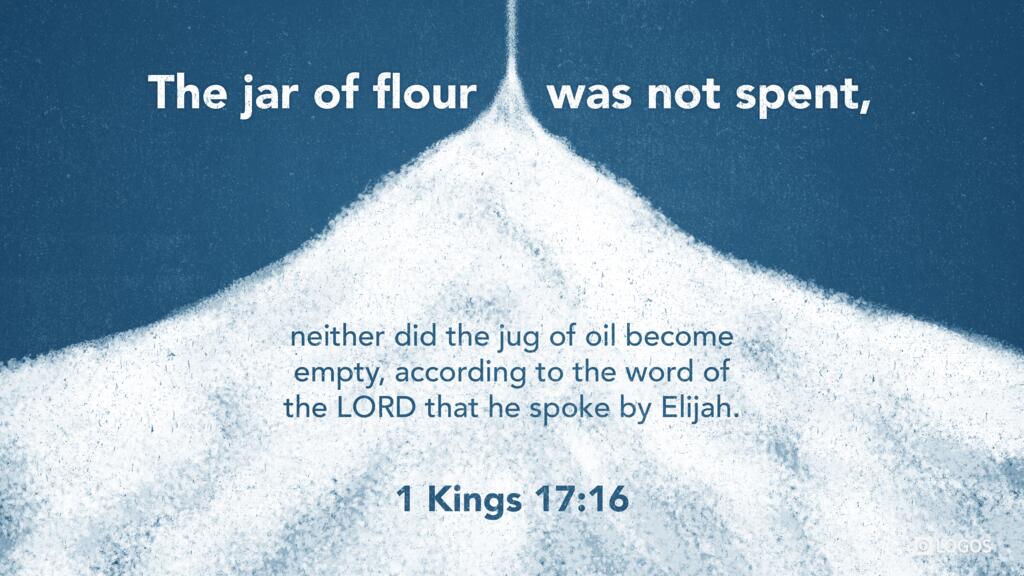
17:8The Lord told him,817:9“Get up, go to Zarephath in Sidonian territory, and live there. I have already told9 a widow who lives there to provide for you.” 17:10So he got up and went to Zarephath. When he went through the city gate, there was a widow gathering wood. He called out to her, “Please give me a cup10 of water, so I can take a drink.” 17:11As she went to get it, he called out to her, “Please bring me a piece of bread.”1117:12She said, “As certainly as the Lord your God lives, I have no food, except for a handful of flour in a jar and a little olive oil in a jug. Right now I am gathering a couple of sticks for a fire. Then I’m going home to make one final meal for my son and myself. After we have eaten that, we will die of starvation.”1217:13Elijah said to her, “Don’t be afraid. Go and do as you planned.13 But first make a small cake for me and bring it to me; then make something for yourself and your son. 17:14For this is what the Lord God of Israel says, ‘The jar of flour will not be empty and the jug of oil will not run out until the day the Lord makes it rain on the surface of the ground.’ ” 17:15She went and did as Elijah told her; there was always enough food for Elijah and for her and her family.1417:16The jar of flour was never empty and the jug of oil never ran out, just as the Lord had promised15 through Elijah.
17:17After this16 the son of the woman who owned the house got sick. His illness was so severe he could no longer breathe. 17:18She asked Elijah, “Why, prophet, have you come17 to me to confront me with18 my sin and kill my son?” 17:19He said to her, “Hand me your son.” He took him from her arms, carried him to the upper room where he was staying, and laid him down on his bed. 17:20Then he called out to the Lord, “O Lord, my God, are you also bringing disaster on this widow I am staying with by killing her son?” 17:21He stretched out over the boy three times and called out to the Lord, “O Lord, my God, please let this boy’s breath return to him.” 17:22The Lord answered Elijah’s prayer; the boy’s breath returned to him and he lived. 17:23Elijah took the boy, brought him down from the upper room to the house, and handed him to his mother. Elijah then said, “See, your son is alive!” 17:24The woman said to Elijah, “Now I know that you are a prophet and that the Lord really does speak through you.”19
Footnotes
- 8 Heb “And the word of the Lord came to him, saying.”
- 9 Heb “Look, I have commanded.”
- 10 Heb “a little.”
- 11 The Hebrew text also includes the phrase “in your hand.”
- 12 Heb “Look, I am gathering two sticks and then I will go and make it for me and my son and we will eat it and we will die.”
- 13 Heb “according to your word.”
- 14 Heb “and she ate, she and he and her house [for] days.”
- 15 Heb “out, according to the word of the Lord which he spoke.”
- 16 Heb “after these things.”
- 17 Heb “What to me and to you, man of God, that you have come.”
- 18 Heb “to make me remember.”
- 19 Heb “you are a man of God and the word of the Lord is truly in your mouth.” This episode is especially significant in light of Ahab’s decision to promote Baal worship in Israel. In Canaanite mythology the drought that swept over the region (v. 1) would signal that Baal, a fertility god responsible for providing food for his subjects, had been defeated by the god of death and was imprisoned in the underworld. While Baal was overcome by death and unable to function like a king, Israel’s God demonstrated his sovereignty and superiority to death by providing food for a widow and restoring life to her son. And he did it all in Sidonian territory, Baal’s back yard, as it were. The episode demonstrates that Israel’s God, not Baal, is the true king who provides food and controls life and death. This polemic against Baalism reaches its climax in the next chapter, when the Lord proves that he, not Baal, controls the elements of the storm and determines when the rains will fall.
The NET Bible First Edition, Copyright 1996-2005 by Biblical Studies Press