1 Corinthians 1:10–31
The NET BibleOther versions
English
- NET The NET Bible
- DARBY 1890 Darby Bible
- ASV American Standard Version
- AV 1873 The Cambridge Paragraph Bible of the Authorized English Version
- CSB Christian Standard Bible
- D-R Douay-Rheims Bible
- ESV English Standard Version
- GW GOD’S WORD Translation
- GNB Good News Translation
- HCSB The Holman Christian Standard Bible
- KJV 1900 King James Version
- LSB Legacy Standard Bible
- LEB The Lexham English Bible
- MSG The Message: The Bible in Contemporary Language
- NASB95 New American Standard Bible (1995)
- NCV New Century Version
- NIrV New International Reader’s Version (1998)
- NIV New International Version (2011)
- NKJV The New King James Version
- NLT New Living Translation
- NRSVue New Revised Standard Version: Updated Edition
- RSV The Revised Standard Version
- RSVCE The Revised Standard Version, Catholic Edition
- YLT Young’s Literal Translation
Arabic
Czech
French
German
Greek
Hungarian
Italian
Korean
Latin
Portuguese
Russian
Simplified Chinese
Spanish
Traditional Chinese
Divisions in the Church
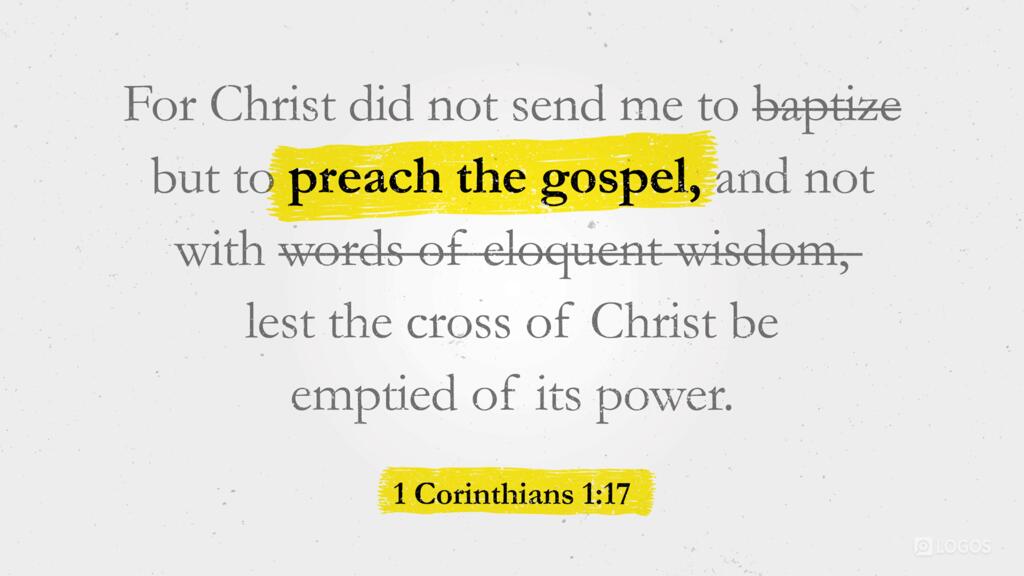
1:10I urge you, brothers and sisters,10 by the name of our Lord Jesus Christ, to agree together,11 to end your divisions,12 and to be united by the same mind and purpose.131:11For members of Chloe’s household have made it clear to me, my brothers and sisters,14 that there are quarrels15 among you. 1:12Now I mean this, that16 each of you is saying, “I am with Paul,” or “I am with Apollos,” or “I am with Cephas,” or “I am with Christ.” 1:13Is Christ divided? Paul wasn’t crucified for you, was he?17 Or were you in fact baptized in the name of Paul?181:14I thank God19 that I did not baptize any of you except Crispus and Gaius, 1:15so that no one can say that you were baptized in my name! 1:16(I also baptized the household of Stephanus. Otherwise, I do not remember whether I baptized anyone else.) 1:17For Christ did not send me to baptize, but to preach the gospel—and not with clever speech, so that the cross of Christ would not become useless.20
The Message of the Cross
1:18For the message about the cross is foolishness to those who are perishing, but to us who are being saved it is the power of God. 1:19For it is written, “I will destroy the wisdom of the wise, and I will thwart the cleverness of the intelligent.”211:20Where is the wise man? Where is the expert in the Mosaic law?22 Where is the debater of this age? Has God not made the wisdom of the world foolish? 1:21For since in the wisdom of God the world by its wisdom did not know God, God was pleased to save those who believe by the foolishness of preaching. 1:22For Jews demand miraculous signs and Greeks ask for wisdom, 1:23but we preach about a crucified Christ,23 a stumbling block to Jews and foolishness to Gentiles. 1:24But to those who are called, both Jews and Greeks, Christ is the power of God and the wisdom of God. 1:25For the foolishness of God is wiser than human wisdom,24 and the weakness of God is stronger than human strength.25
1:26Think about the circumstances of your call,26 brothers and sisters.27 Not many were wise by human standards,28 not many were powerful, not many were born to a privileged position.291:27But God chose what the world thinks foolish to shame the wise, and God chose what the world thinks weak to shame the strong. 1:28God chose30 what is low and despised in the world, what is regarded as nothing, to set aside what is regarded as something, 1:29so that no one can boast in his presence. 1:30He is the reason you have a relationship with Christ Jesus,31 who became for us wisdom from God, and righteousness and sanctification and redemption, 1:31so that, as it is written, “Let the one who boasts, boast in the Lord.”32
Footnotes
- 10 Grk “brothers,” but the Greek word may be used for “brothers and sisters” or “fellow Christians” as here (cf. ἀδελφός 1, where considerable nonbiblical evidence for the plural ἀδελφοί [adelphoi] meaning “brothers and sisters” is cited).
- 11 Grk “that you all say the same thing.”
- 12 Grk “that there be no divisions among you.”
- 13 Grk “that you be united in/by the same mind and in/by the same purpose.”
- 14 Grk “brothers.” See note on the phrase “brothers and sisters” in .
- 15 Or “rivalries, disputes.”
- 16 Or “And I say this because.”
- 17 Questions prefaced with μή (mē) in Greek anticipate a negative answer. This can sometimes be indicated by using a “tag” at the end in English (here the tag is “was he?”).
- 18 This third question marks a peak in which Paul’s incredulity at the Corinthians’ attitude is in focus. The words “in fact” have been supplied in the translation to make this rhetorical juncture clear.
- 19 The oldest and most important witnesses to this text, as well as a few others (א* B 6 1739 sams bopt), lack the words τῷ θεῷ (tō theō, “God”), while the rest have them. An accidental omission could well account for the shorter reading, especially since θεῷ would have been written as a nomen sacrum (ΕΥΧΑΡΙΣΤΩΤΩΘ Ω). However, one might expect to see, in some at least, a dropping of the article but not the divine name. Internally, the Pauline introductory thanksgivings elsewhere always include τῷ θεῷ after εὐχαριστῶ (eucharistō, “I thank”; cf. Rom 1:8; 1 Cor 1:4; Phil 1:3; Phlm 4; in the plural, note Col 1:3; 1 Thess 1:2). However, both the fact that this is already used in 1 Cor 1:4 (thus perhaps motivating scribes to add it ten verses later), and that in later portions of his letters Paul does not consistently use the collocation of εὐχαριστῶ with τῷ θεῷ (Rom 16:4; 1 Cor 10:30), might give one pause. Still, nowhere else in the corpus Paulinum do we see a sentence begin with εὐχαριστῶ without an accompanying τῷ θεῷ. A decision is difficult, but on balance it is probably best to retain the words.
- 20 Grk “would not be emptied.”
- 21 A quotation from Isa 29:14.
- 22 Grk “the scribe.” The traditional rendering of γραμματεύς (grammateus) as “scribe” does not communicate much to the modern English reader, for whom the term might mean “professional copyist,” if it means anything at all. The people referred to here were recognized experts in the law of Moses and in traditional laws and regulations. Thus “expert in the Mosaic law” comes closer to the meaning for the modern reader.
- 23 Or “Messiah”; Grk “preach Christ [Messiah] crucified,” giving the content of the message.
- 24 Grk “than men.”
- 25 Grk “than men.”
- 26 Grk “Think about your calling.” “Calling” in Paul’s writings usually refers to God’s work of drawing people to faith in Christ. The following verses show that “calling” here stands by metonymy for their circumstances when they became Christians, leading to the translation “the circumstances of your call.”
- 27 Grk “brothers.” See note on the phrase “brothers and sisters” in .
- 28 Grk “according to the flesh.”
- 29 The Greek word ευγενής (eugenēs) refers to the status of being born into nobility, wealth, or power with an emphasis on the privileges and benefits that come with that position.
- 30 Here καί (kai) has not been translated because of differences between Greek and English style.
- 31 Grk “of him you are in Christ Jesus.”
- 32 A quotation from Jer 9:24. The themes of Jer 9 have influenced Paul’s presentation in vv. 26–31. Jeremiah calls upon the wise, the strong, and the wealthy not to trust in their resources but in their knowledge of the true God—and so to boast in the Lord. Paul addresses the same three areas of human pride.
The NET Bible First Edition, Copyright 1996-2005 by Biblical Studies Press