1 Corinthians 9:15–23
1890 Darby BibleOther versions
English
- DARBY 1890 Darby Bible
- ASV American Standard Version
- AV 1873 The Cambridge Paragraph Bible of the Authorized English Version
- CSB Christian Standard Bible
- D-R Douay-Rheims Bible
- ESV English Standard Version
- GW GOD’S WORD Translation
- GNB Good News Translation
- HCSB The Holman Christian Standard Bible
- KJV 1900 King James Version
- LSB Legacy Standard Bible
- LEB The Lexham English Bible
- MSG The Message: The Bible in Contemporary Language
- NET The NET Bible
- NASB95 New American Standard Bible (1995)
- NCV New Century Version
- NIrV New International Reader’s Version (1998)
- NIV New International Version (2011)
- NKJV The New King James Version
- NLT New Living Translation
- NRSVue New Revised Standard Version: Updated Edition
- RSV The Revised Standard Version
- RSVCE The Revised Standard Version, Catholic Edition
- YLT Young’s Literal Translation
Arabic
Czech
French
German
Greek
Hungarian
Italian
Korean
Latin
Portuguese
Russian
Simplified Chinese
Spanish
Traditional Chinese
15But I have used none of these things. Now I have not written these things that it should be thus in my case; for it were good for me rather to die than that any one should make vain my boast. 16For if I announce the glad tidings, I have nothing to boast of; for a necessity is laid upon me; for it is woe to me if I should not announce the glad tidings. 17For if I do this voluntarily, I have a reward; but if not of my own will, I am entrusted with an administration. 18What is the reward then that I have? That in announcing the glad tidings I make the glad tidings costless to others, so as not to have made use, as belonging to me, of my right in announcing the glad tidings.
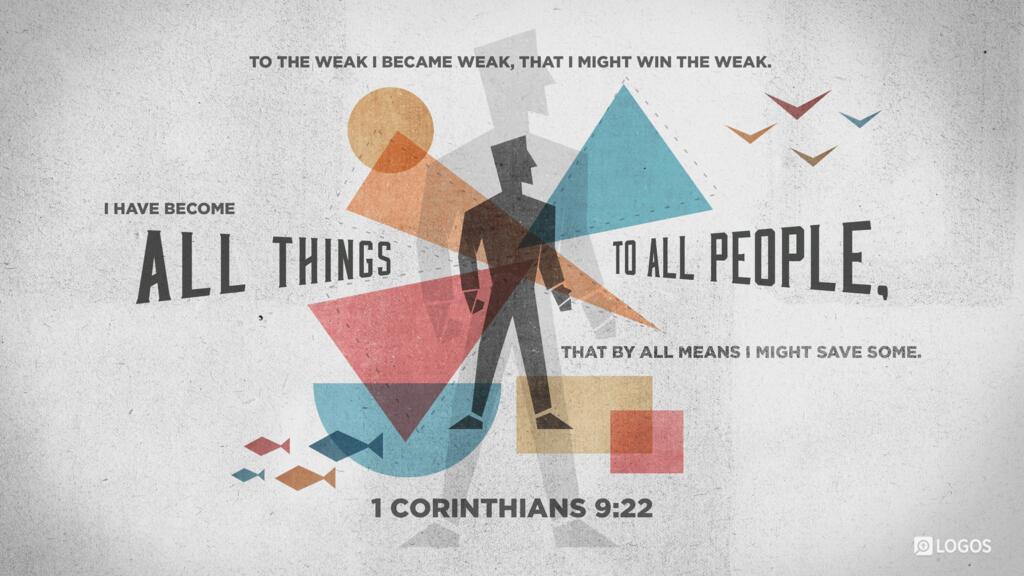
19For being free from all, I have made myself bondman to all, that I might gain the most possible. 20And I became to the Jews as a Jew, in order that I might gain the Jews: to those under law, as under law, not being myself under law, in order that I might gain those under law: 21to those without law, as without law, (not as without law to God, but as legitimately subject to Christ,) in order that I might gain those without law. 22I became to the weak, as weak, in order that I might gain the weak. To all I have become all things, in order that at all events I might save some. 23And I do all things for the sake of the glad tidings, that I may be fellow-partaker with them.
Public Domain